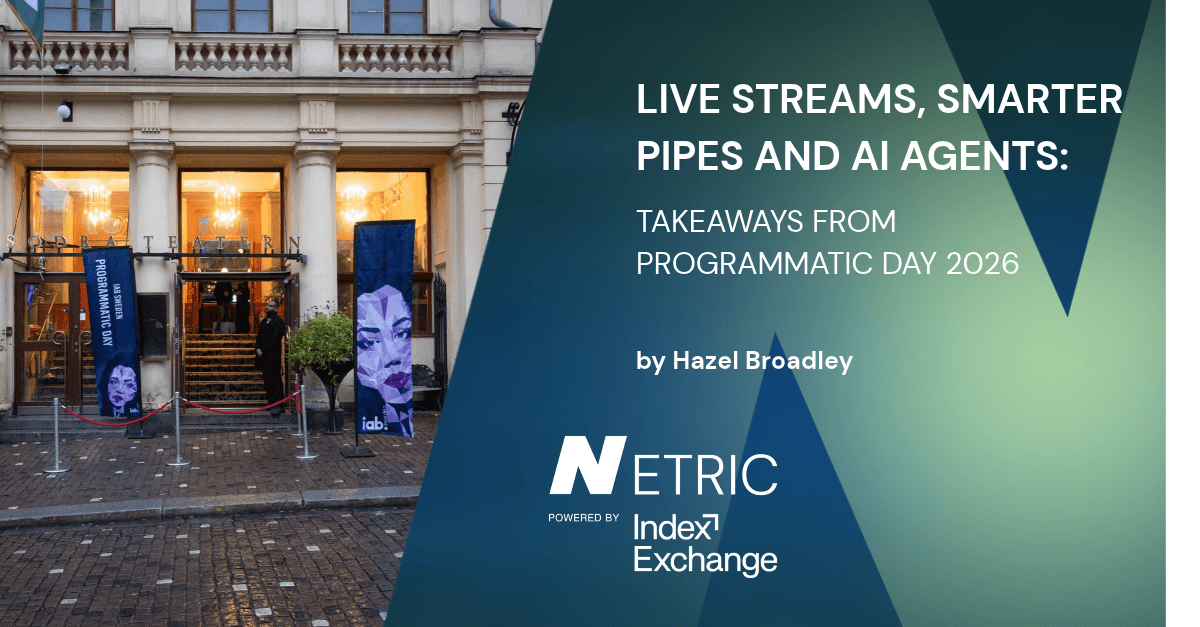
Last month, the Netric team was out in full force alongside around 750 people from across the Nordic programmatic industry at Södra Teatern in Stockholm for IAB Sweden's Programmatic Day 2026.
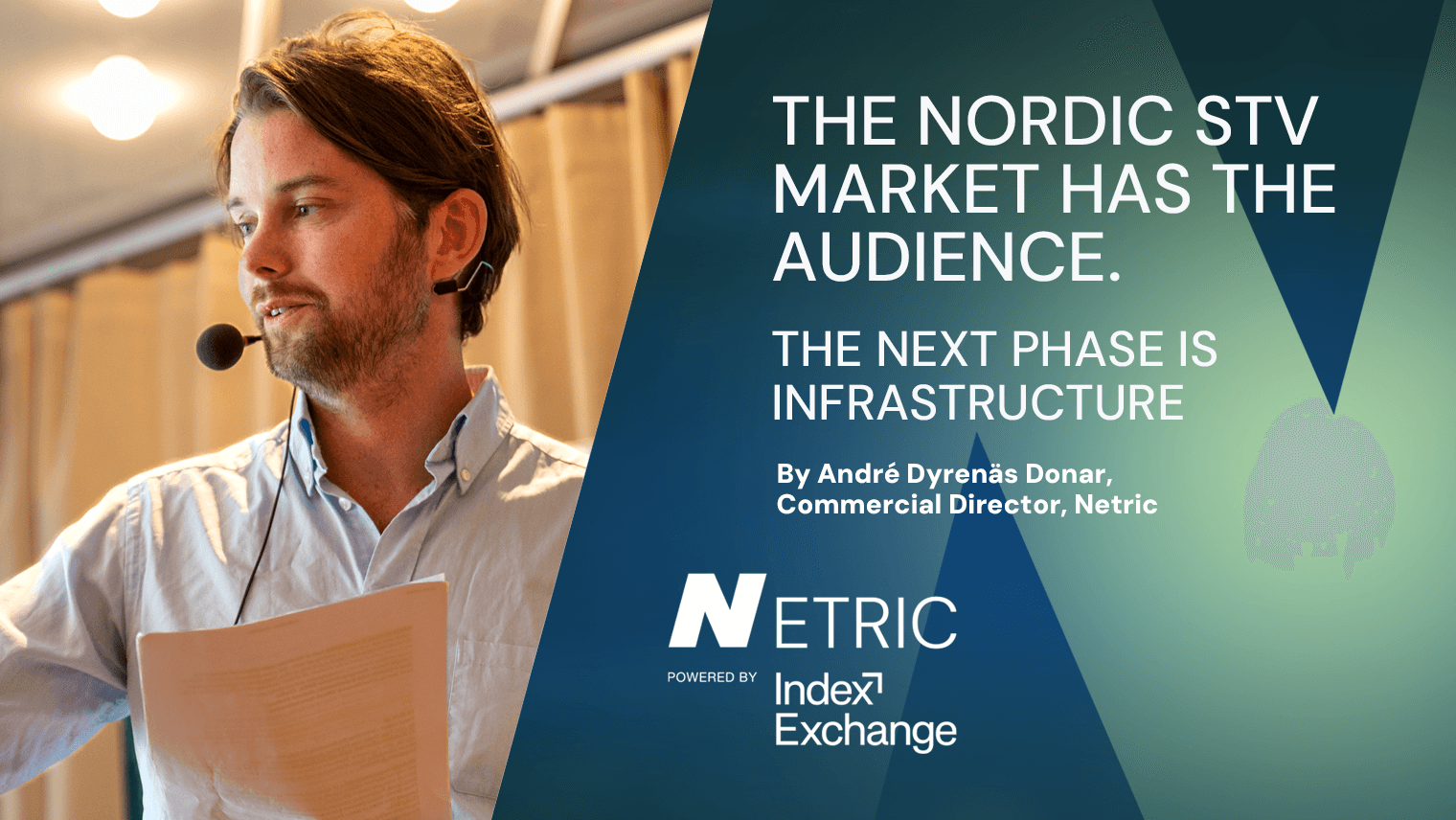
Our very own Commercial Director, André Dyrenäs, was on stage filling us in on the latest trends in streaming TV, and our CEO, Daniel Ahlbert, closed the day alongside Linda Andersson from Omnicom.
Meanwhile, we explored how SSP technology is changing, where agentic advertising really stands, Anthony Katsur's update on IAB Tech Lab standards, Daniel Knapp's view of the market, and what all of this means for publishers and buyers.
STV: ad-funded streaming is now the norm
André opened with a striking statistic. Of the roughly 3.5 million new streaming subscriptions in the Nordics this year, 80% were ad-funded, largely thanks to more cost-effective hybrid tiers. As he explained, "we've gone from 'I pay to avoid ads' to ads being fine if it's cheaper".
The catch is that much of the programmatic infrastructure behind STV was built for web and app. Signals can be missing or inconsistent, and viewers can see the same ad several times a day. André showed how OpenRTB 2.6, which Index led with IAB Tech Lab, tackles this with ad pod support, describing an entire ad break in a single request. The results include a 25% higher win rate, 70% savings in QPS and 84% fewer timeouts.
Live sport is the next test. When the break starts during a match like this summer's World Cup final, ads must reach millions of viewers at once. "We can't exactly pause the match to get the ads in," André noted. Index is responding with Extended Content IDs, shared routines for approving creative in advance, and pod-based integrations with DSPs. "When viewers move, we in the infrastructure have to move with them."
The STV panel echoed the pressure on supply. Edouard Lauwick from Rakuten TV warned that oversupply is pushing fill rates down, which will drive consolidation, while IRM’s Madeline Thor expects streamed TV to grow by 30% this year.
SSP technology: from pipes to decisioning
Index’s Mayuran Yogarajah and PubMatic’s Mohsin Pervez both described SSPs moving into the background as trusted infrastructure, while taking on more intelligence. "If we do our job right, then we will be forgotten," said Mayuran. Under the Agentic Real-Time Framework (ARTF), buyers' models can run in containers inside the SSP, applying targeting, enrichment or floor logic in around five milliseconds. Index processes more than 700 billion requests a day and DSPs only see a fraction, so this opens up far more supply to buyers.
In the closing recap, Linda Andersson gave the buyer's view. "SSP, DSP, who cares? As long as it's good, it's good." Daniel added that cutting the back-and-forth of data at internet scale also reduces cost and latency, which Linda pointed out is better for the environment too.
Agentic advertising: early, but real
The results are starting to arrive. Mayuran was clear that agentic is already part of day-to-day work. "A chatbot answers and an agent does the work," he said. Take a deal that stops delivering. Rather than digging through dashboards, a trader can hand the job to an agent, which checks flight dates, frequency caps, creative settings and budgets, then recommends a fix. "What used to be an afternoon of work will now take minutes."
Index's bigger bet is sell-side decisioning. When a DSP's bidder runs as a container inside the exchange, the 150 milliseconds or so usually lost in network transit can be spent on decisioning instead, bringing in first-party data, contextual signals or verification from partners such as IAS and DV. In practice, Mayuran said, that means "more relevant bids, stronger match rates, better performing campaigns."
This is already live. In April, Bedrock became the first DSP to run its bidder inside an exchange, on Index Cloud. Index has also reported a 75% reduction in cost per site visit for a major apparel retailer using sell-side decisioning, and agency PMG is piloting its buying inside the exchange.
Every speaker stressed guardrails and human oversight, and Linda added a note of realism. "There's a lot of talk, but not many have actually adopted it yet or turned it into executable products."
Anthony Katsur and the case for shared standards
IAB Tech Lab’s CEO gave an update on AAMP (Agentic Advertising Management Protocols), the Tech Lab's agentic framework launched in January. Free buyer and seller agent SDKs mean a company can stand up an agent in about 45 minutes, while a new agent registry starts to build a trust layer around who is on the other side of a transaction.
The latest release, version 3.0, adds Open Proposal, a common format that lets seller agents respond to media briefs and buyer agents compare those responses. In tests with Paramount Skydance, buyers could evaluate 10 to 100 times more proposals in minutes. That's good news for publishers, who rarely get the chance to present their full range of ad products.
Anthony was blunt about why this needs standards. "The AI will figure it out. It'll figure it out wrong." Today, he said, the most common use case is curation of PMPs, alongside direct buys in STV, where live content now accounts for 32% of European premium video ad views.
Daniel Knapp on money, media and machines
IAB Europe's Chief Economist argued that programmatic growth in Europe is mostly redistribution, at more than 10% in 2025 against just under 6% for the wider open web. The platforms, he said, work like an orchestra, while the open web has excellent instruments that rarely play together. He expects nearly one in three euros to flow through AI-driven buying by 2030, with Europe's STV and upfront deals giving the open web real potential.
Closing the day with Daniel and Linda
In the final session, Daniel and Linda pulled the threads together. Linda cautioned that the jump in PMP (Private Marketplace) adoption may partly reflect who answered the survey. Daniel highlighted the fireside chat's call for leaders to act on imperfect information, and its warning about data. "If we load it with rubbish, rubbish will come out the other side." They also flagged Netflix's planned ad launch in Sweden next spring.
What publishers and buyers should do next
For publishers, the priorities are clean content metadata, ad pod readiness for live moments, and PMP and PG packages that agents can find.
For buyers and agencies, it's time to understand buyer and seller agents, ask partners which standards they support, and read headline video growth with care, since much of it is YouTube rather than the open web.
From ad-funded STV and smarter SSP pipes, to agentic advertising, new standards, and next steps for both sides, the message was clear. Viewers are moving fast, and the infrastructure behind them needs to keep pace. To talk about any of these topics in more detail, get in touch with the Netric team, or watch the day’s main-stage sessions on demand.